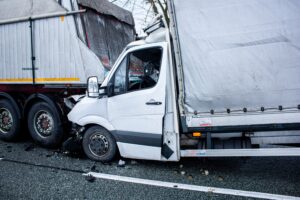
A jackknife accident happens when the trailer of a large commercial truck, like a semi-truck or tractor-trailer, swings out to a 90-degree angle from the cab, creating a terrifying shape that resembles a folding pocketknife.
If you are reading this, you may have experienced a jackknife accident firsthand—the screech of tires, the horrifying sight of a trailer sliding uncontrollably toward you, and the devastating impact that followed. You are now left with physical pain, emotional trauma, mounting medical bills, and a torrent of questions. How could this happen? Why did it happen? And who is responsible for the pain and chaos that has been forced upon you and your family?
Understanding the mechanics of a jackknife accident is the first step, but uncovering the negligence that often lies at its root is the key to securing justice in your case—something an experienced Indianapolis truck accident attorney can help you achieve.
The Terrifying Physics of a Jackknife Accident
To understand who is at fault in a jackknife accident, it helps to first understand the forces at play. A tractor-trailer is not one solid vehicle; it is two distinct parts connected by a crucial pivot point called a fifth-wheel coupling. The tractor (the cab and engine) pulls the trailer (the cargo container). Both the tractor and the trailer have their own sets of wheels and brakes.
A jackknife occurs when the wheels of the tractor lock up during braking, but the wheels of the heavy trailer do not. The tractor begins to skid, but the immense momentum of the trailer keeps it moving forward. With nothing to keep it aligned, the trailer pushes forward and pivots at the coupling, swinging out violently to the side.
This can be triggered by a number of situations:
- Sudden, Hard Braking: A driver slamming on the brakes in an emergency can cause the drive wheels on the tractor to lock.
- Slippery Conditions: Rain, ice, snow, or even an oil slick on the road can dramatically reduce traction, making a wheel lock-up far more likely.
- Taking a Curve Too Fast: The centrifugal force on a speeding, heavy trailer can initiate a swing that the driver cannot control.
- Swerving Abruptly: A sudden maneuver to avoid a road hazard or another vehicle can upset the delicate balance of the rig.
The result is one of the most dangerous scenarios on our Indiana highways. A jackknifing trailer can sweep across multiple lanes of traffic, crushing smaller vehicles, causing multi-car pile-ups, and leaving a wide path of destruction. For anyone caught in its way, the consequences are often catastrophic, leading to severe injuries or, in the most tragic cases, wrongful death.
The Root Causes: Uncovering the Negligence Behind the “Accident”
While a jackknife might seem like a freak event caused by bad luck or bad weather, the truth is that the vast majority of these incidents are preventable. They are not simply “accidents” but are the direct result of negligence—a failure by someone to act with reasonable care. Determining liability requires a deep investigation into what went wrong and why. The cause often falls into one of several key categories.
Truck Driver Error
 The person behind the wheel has an immense responsibility. Commercial truck drivers are held to a higher standard than regular motorists because of the size and danger of their vehicles. When they fail to meet that standard, the results are devastating. Common driver errors that lead to jackknifing include:
- Speeding: This is the most common factor. A driver traveling too fast for road conditions, whether it’s a wet surface, a sharp curve, or heavy traffic, loses the time and distance needed to brake safely and maintain control.
- Improper Braking: Professional drivers are trained on special braking techniques to prevent a jackknife, such as “stabbing” the brakes (applying and releasing them) rather than slamming them down. Panic braking or improper technique is a frequent cause.
- Fatigue: Federal regulations, known as Hours of Service rules, strictly limit how long a driver can be on the road without rest. Unfortunately, trucking companies often pressure drivers to meet unrealistic deadlines, leading them to drive while drowsy. A fatigued driver has slower reaction times and impaired judgment, making them far more likely to make a critical error.
- Distracted Driving: Texting, adjusting a GPS, eating, or doing anything that takes a driver’s eyes or mind off the road, even for a few seconds, can lead to a situation that requires a sudden, disastrous maneuver.
- Inexperience or Lack of Training: Operating an 80,000-pound rig is a highly specialized skill. A driver who hasn’t been properly trained on how to handle adverse weather, emergency situations, or the specific characteristics of their truck is a danger to everyone on the road.
Poor Vehicle Maintenance and Mechanical Failure
You trust the massive truck driving next to you is in safe working order. Legally, it is required to be. Trucking companies have a non-negotiable duty to regularly inspect, maintain, and repair their entire fleet. When they cut corners to save money, they put lives at risk.
A thorough investigation after a jackknife accident often reveals critical mechanical failures, such as:
- Faulty Brakes: This is a primary cause. If the brakes on the tractor and trailer are unbalanced, meaning one set grabs harder or faster than the other, it can directly cause a jackknife. Worn-out brake pads, leaking air lines, or improperly adjusted brakes are signs of serious maintenance neglect.
- Worn or Mismatched Tires: A truck’s tires are its only connection to the road. Insufficient tread depth, improper inflation, or using mismatched tires can severely compromise traction, especially on wet or slick surfaces, making a skid and subsequent jackknife almost inevitable.
- Defective Fifth-Wheel Coupling: The coupling that connects the tractor and trailer must be properly lubricated and free of defects. If it fails or functions improperly, it can contribute to a loss of control.
- Other Equipment Failures: Issues with steering, suspension, or other critical systems can also lead to a driver losing control and causing a collision.
Improper Cargo Loading
The way cargo is loaded into a trailer is a matter of science and safety. An improperly loaded trailer can be dangerously unstable. If the weight is not distributed evenly or if the load is not properly secured, it can shift during transit.
- Top-Heavy Loads: A high center of gravity makes a trailer much more likely to tip or swing out in a turn.
- Unbalanced Loads: Too much weight concentrated in the back or on one side of the trailer can disrupt the truck’s stability and braking performance.
- Shifting Cargo: If a load breaks free from its restraints and slides forward, backward, or to the side, it can cause a sudden and dramatic change in the vehicle’s dynamics, often initiating an uncontrollable swing.
The Complex Web of Liability: Who Is Liable in a Jackknife Accident?
As you can see, the cause of a jackknife accident is rarely simple. Because so many different factors and parties can be involved, determining who is legally and financially responsible is a complex process. This is why it is so difficult for victims to navigate these claims on their own. Liability can fall on one or more of the following parties:
- The Truck Driver
If the accident was caused by their direct negligence, such as speeding, distraction, or driving under the influence.
- The Trucking Company (Motor Carrier)
This is often the primary responsible party. Under a legal principle known as vicarious liability, employers are responsible for the negligent acts of their employees. Beyond that, the company can be held directly liable for its own negligence, including:
- Negligent Hiring: Hiring a driver with a known history of reckless driving or safety violations.
- Inadequate Training: Failing to ensure their drivers are fully competent to handle their rigs in all conditions.
- Pressuring Drivers: Encouraging or forcing drivers to violate Hours of Service rules to meet deadlines.
- Failure to Maintain: Neglecting their legal duty to keep their trucks in a safe and roadworthy condition. Maintenance logs, inspection reports, and driver records are critical pieces of evidence here.
- The Cargo Shipper or Loader
If evidence shows that an improperly loaded or secured cargo was a substantial factor in causing the jackknife, the company responsible for that loading can be held liable.
- A Parts Manufacturer
In some cases, the accident is caused by a defective part—a tire that blows out, brakes that fail, or a faulty coupling. In this situation, the manufacturer of that part can be held liable under product liability laws.
- A Third-Party Maintenance Shop
If the trucking company outsourced its vehicle maintenance to another company, and that company performed shoddy or incomplete work, they could share in the liability for the resulting crash.
Identifying all potential sources of liability is absolutely critical. It ensures that you are pursuing compensation from every responsible party, which is essential for securing the full and fair recovery you need to rebuild your life. This requires a meticulous investigation that goes far beyond a simple police report; it involves preserving evidence, hiring accident reconstruction experts, and subpoenaing records that companies would rather keep hidden.
The Insurance Company’s Playbook: The Fight After the Crash
After a traumatic event like a jackknife accident, you would hope that the responsible parties and their insurance companies would step up and do the right thing. Unfortunately, that is rarely how it works.
Large trucking companies are backed by massive insurance corporations. These insurers are not in the business of compassion; they are in the business of profits. From the moment they learn of the crash, their goal is to minimize their financial exposure and pay you as little as possible. They have a well-practiced playbook designed to take advantage of you during your most vulnerable time.
These multi-billion-dollar corporations see you as an obstacle to their bottom line. They see you as a number on a spreadsheet. But you are a human being. Your life, your hopes, your dreams, and your future have a value that can never be calculated on a balance sheet. The fight for justice is not just about paying your medical bills; it is about holding these powerful entities accountable and ensuring your true, human value is recognized and respected.
Yosha Law: Fighting for Truck Accident Victims
 The moments and days following a devastating truck accident are overwhelming. You are focused on healing, on your family, and on trying to piece your life back together. The last thing you should have to do is battle a team of experienced insurance adjusters and corporate lawyers on your own.
You need someone in your corner who sees you as a person, not a case file. You need a team that is not afraid to take on the largest insurance companies in America and hold them fully accountable.
At Yosha Law, we have been fighting for injured Hoosiers and their families since 1963. We understand the terror and devastation caused by jackknife accidents, and we know the tactics insurers use to rob victims of their rights.
If you or someone you love has been harmed in a jackknife truck accident, do not let an insurance company define the value of your life. Contact our Indianapolis personal injury lawyers today at (317) 334-9200 or through our online form for a free, confidential consultation.
We will listen to your story with compassion, answer your questions, and provide you with clear, honest advice on your options for seeking justice and compensation.