The sound is one you’ll never forget. Not just a single crash, but a sequence of them—a terrifying chorus of screeching tires, crunching metal, and shattering glass that seems to go on forever. In those first few moments, there is only shock and disorientation. The scene outside your window is one of pure chaos. Cars are accordioned together, pointing in every direction, and smoke or steam may be rising into the air.
Your first thought is likely, “Am I okay?” Your second is for your passengers, and your third is often a dizzying question: What just happened? And who is responsible for all of this?
If you are reading this, you have likely survived one of the most frightening and confusing events a person can experience on the road: a multi-car pile-up. The physical pain is real, the emotional trauma is heavy, and the path forward looks anything but clear. You are not just dealing with a simple fender-bender; you are at the center of a complex web of intersecting forces, and the question of fault is far from simple. A skilled Indianapolis car accident attorney can help you navigate this complicated legal terrain and fight for your deserved compensation.
Determining who is responsible in a multi-car pile-up is a complicated process. But it is key to protecting yourself, your family, and your future.
Why Multi-Car Accidents Are So Complicated
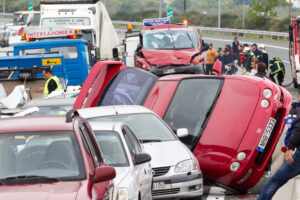 In a typical two-car accident, determining fault can be relatively straightforward. One driver ran a red light, another was texting, or someone made an improper lane change. But a pile-up is different. It’s a chain reaction, where one act of negligence can set off a cascade of collisions.
The core legal principle at play in any accident is negligence. In simple terms, every driver has a duty to operate their vehicle with reasonable care to avoid harming others. When a driver breaches that duty—by speeding, following too closely, or being distracted—and that breach causes an accident that results in injuries, they are considered negligent and, therefore, legally responsible (or “liable”) for the damages they caused.
The challenge in a multi-car pile-up is that there can be, and often are, multiple acts of negligence by multiple drivers.
- The driver who caused the very first impact may be at fault.
- A driver two or three cars back, who was following too closely to stop in time, may also be at fault.
- A driver who swerved suddenly without signaling could have contributed.
- Even external factors like poor weather or a hazardous road condition can play a role, adding another layer of complexity.
Untangling this knot requires a careful, methodical investigation to trace the sequence of events back to each and every act of negligence. It’s not about finding one person to blame; it’s about identifying everyone whose carelessness contributed to the harm you have suffered.
Common Scenarios and How Fault is Assessed
While every pile-up is unique, most fall into a few common patterns. Understanding these can help you begin to make sense of what happened in your own accident.
Scenario 1: The Classic Chain Reaction
This is the most frequent type of multi-car accident. It starts when a driver (let’s call them Driver A) fails to stop and rear-ends the car in front of them (Car B). The force of that impact pushes Car B forward into Car C.
In this scenario, fault almost always lies with Driver A. The law requires every driver to maintain a safe following distance, allowing them enough time and space to stop if the traffic ahead suddenly slows or halts. Failing to do so is a clear breach of their duty of care. Even if Car B stopped abruptly, Driver A is expected to be prepared for such possibilities.
Scenario 2: The “Sandwich” Collision
This is a variation of the chain reaction that can sometimes confuse liability. Imagine you are the driver of Car B. You are stopped in traffic. Suddenly, you are violently struck from behind by Driver C, and the impact propels your car forward into Car A. You have been “sandwiched” between two other vehicles.
Who is at fault? In the vast majority of these cases, the driver of the rear-most vehicle, Driver C, is held responsible for the entire sequence. Their initial negligence—hitting you from behind—was the direct cause of you then hitting the car in front of you. You had no control over the situation. However, insurance companies will often try to complicate this. They might argue that you, too, were following Car A too closely, even though you were stopped when you were hit. This is a tactic designed to shift blame and reduce their payout.
Scenario 3: The Lane-Change or “Phantom Vehicle” Pile-Up
Sometimes, a pile-up is triggered by a driver whose vehicle never even makes contact with yours. For instance, a driver (Driver X) might recklessly cut into your lane, forcing you to slam on your brakes. The car behind you, which was following at a safe distance, manages to stop in time. But the car behind them does not, setting off a chain reaction.
In this situation, Driver X, the one who made the unsafe lane change, bears significant responsibility, even if their car is untouched. If they flee the scene, they are often referred to as a “phantom vehicle.” Proving their role can be difficult and often requires eyewitness testimony or traffic camera footage. Additionally, the drivers in the chain reaction who failed to stop in time may also share a percentage of the fault.
Scenario 4: The Role of Weather and Road Conditions
Pile-ups are notoriously common in adverse weather conditions like dense fog, heavy rain, snow, or on icy Indiana roads. When this happens, insurance companies love to blame the weather, as if it were an “Act of God” that absolves their driver of responsibility.
This is a deeply misleading argument. While weather is certainly a factor, it does not erase a driver’s duty of care. In fact, the law requires drivers to be more cautious in dangerous conditions. They have a responsibility to slow down, increase their following distance, and adjust their driving to match the environment. A driver who causes an accident on an icy road because they were driving at the posted speed limit can still be found negligent, because a reasonable driver would have slowed down significantly.
Understanding “Comparative Fault” in Indiana
Here in Indiana, we operate under a legal rule called the Modified Comparative Fault Rule. This is one of the most important concepts for you to understand, because it’s the rule insurance companies will try to use against you.
This rule says that you can still recover financial compensation for your injuries even if you are found to be partially at fault for the accident, as long as your share of the blame is 50% or less.
Here’s how it works in practice:
- Let’s say an investigation determines that your total damages (medical bills, lost wages, pain and suffering) are $100,000.
- The court also determines that another driver was 80% at fault, but that you were 20% at fault (perhaps for not braking as quickly as you could have).
- Under Indiana’s rule, your final compensation award would be reduced by your percentage of fault. You would receive $100,000 minus 20% ($20,000) for a total recovery of $160,000.
- However, if you are found to be 51% or more at fault, you are barred from recovering anything at all.
You can now see the insurance company’s playbook. Their goal is to shift as much blame as possible onto you and every other victim involved. If they can convince a judge or jury that your fault was even a tiny bit over that 50% threshold, they pay nothing. This is why their adjusters might call and ask leading questions, trying to get you to admit to anything that they can use to assign you a higher percentage of fault.
Building Your Case: The Evidence That Matters
To counter the insurance company’s tactics and establish the truth of what happened, a strong case must be built on a foundation of solid evidence. Proving fault in a complex pile-up isn’t about who tells the most convincing story; it’s about who has the evidence to back it up.
Key pieces of evidence include:
- The Official Police Report: This is the first and most important document. It will contain the officer’s initial assessment of fault, diagrams of the scene, and contact information for all drivers and witnesses.
- Photos and Videos: Nothing tells a story like visual evidence. Photos of the final positions of the vehicles, the damage to each car, skid marks on the road, and any relevant road signs or weather conditions are invaluable. Photos of your injuries are also crucial.
- Witness Statements: Independent witnesses have no stake in the outcome and are often seen as the most credible source of information. Their account of the sequence of events can be powerful in cutting through the finger-pointing from other drivers.
- Medical Records: Your medical records provide the official link between the accident and your injuries. It is essential to seek medical attention immediately after an accident and to be completely honest with your doctors about all of your symptoms, both physical and emotional.
- Expert Analysis: In complex cases, it is often necessary to hire accident reconstruction experts. These are engineers and former law enforcement specialists who can analyze all the evidence—vehicle damage, skid marks, black box data—to scientifically reconstruct the accident and determine the speeds, forces, and sequence of impacts.
Gathering and preserving this evidence while you are also trying to recover from your injuries can feel like an impossible task. This is where having an experienced advocate in your corner can make all the difference.
What Compensation Is Available to Accident Victims?
Insurance companies want you to believe that justice is about paying your existing medical bills. But that is not justice. That is simply accounting.
Full and fair compensation, under Indiana law, is about making you whole again. It’s about recognizing every single way this accident has impacted your life and ensuring the responsible parties are held accountable for all of it. This includes:
- Economic Damages: This is the financial part. It covers all past and future medical expenses, lost wages from time off work, and your diminished capacity to earn a living in the future if your injuries are permanent.
- Non-Economic Damages: This is the human part. It is compensation for the physical pain and suffering you have endured and will continue to endure. It is for the emotional distress, the anxiety, the PTSD, and the fear. It is for the loss of enjoyment of life—the inability to play your favorite sport, work in your garden, or simply live without pain. It is for the damage to your relationship with your spouse.
You only have one opportunity to get this right. Once you accept a settlement, you cannot go back and ask for more, even if your injuries turn out to be far worse than you initially thought.
You Have One Shot at Full Justice. Let Us Help You Take It.
 At Yosha Law, we have been fighting for injured Hoosiers in Indianapolis and across Indiana since 1963. We understand the chaos you’re living through, and we know the insurance company’s playbook by heart. We’ve taken on the largest insurance companies in America and won. To them, you might just be a claim number. To us, you are a human being whose life has been shattered by someone else’s carelessness.
After an accident, your health, your family, and your financial future are on the line. Don’t let an insurance company devalue your life. If you or a loved one has been injured in a multi-car accident, contact our Indianapolis personal injury law firm today at (317) 334-9200 or through our online form for a free, confidential consultation. We will give you honest advice on your case and explain all of your legal options. Let us fight in your corner.