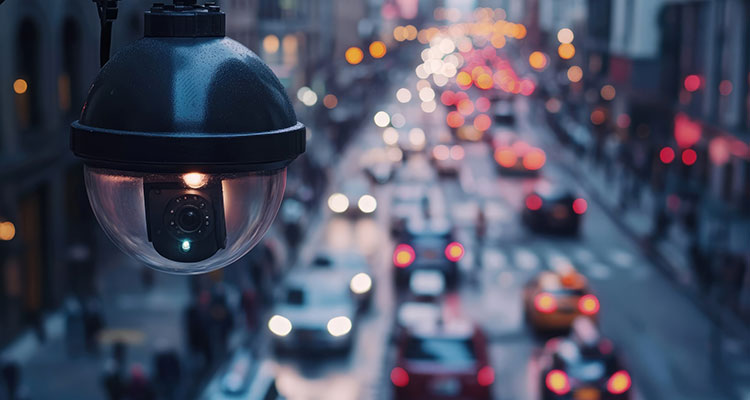
The driver’s story is already forming. They will say you stepped out from nowhere, that they never had a chance to stop. After being struck by a car, it becomes your word against theirs. High above the streets of Indianapolis or Fort Wayne, however, an unblinking eye may have recorded the truth.
Securing and using traffic camera footage is one of the most powerful ways to strengthen pedestrian accident claims and silence the excuses of a negligent driver.
This objective, digital evidence can dismantle an insurance company’s defense and show exactly what happened. This footage is not saved forever. The city, state, or a private business can erase this proof in a matter of days.

Our firm knows that immediate legal action is necessary to preserve it.
The unblinking eye
- Traffic cameras provide unbiased, factual evidence that can definitively prove a driver’s negligence and defeat the “he said, she said” nature of a claim.
- This footage is not stored indefinitely; government agencies and businesses often delete recordings on short, automated loops, sometimes within 72 hours.
- Insurance companies will fight to prevent you from obtaining camera footage or will attempt to misinterpret it to unfairly blame you, the pedestrian.
- Our attorneys use formal legal demands to compel entities to preserve this footage, securing the evidence needed to fight for fair compensation.
The Power of Objective Evidence in Pedestrian Claims
After a driver hits a pedestrian, their insurance company immediately begins to look for ways to assign blame to the victim. They rely on the lack of clear evidence to create confusion. Traffic camera footage cuts through this confusion with facts.
An unbiased digital witness
Without video, a case often comes down to the driver’s testimony versus yours. The driver may claim you darted into the street unexpectedly. They might say you were distracted or not using a crosswalk.
These are common tactics to activate Indiana’s comparative fault law and reduce or deny your claim. A camera has no bias. It records what happened, providing a clear record that confirms your account of the events.
What traffic cameras reveal
A short video clip contains a wealth of information that proves a driver’s carelessness. Trained analysts can examine the footage to expose specific acts of negligence. This can include evidence of a driver running a red light, failing to yield to a pedestrian in a crosswalk, or approaching an intersection at a dangerously high speed.
The video can also reveal signs of distracted driving, like the telltale glow of a cell phone screen in a dark cabin.
Establishing a clear timeline of events
Video footage creates an undisputed timeline. It shows the sequence of events with second-by-second precision. An insurer may try to argue that you did not give the driver enough time to react.
The timestamp on a video can prove you had the right-of-way for several seconds before the driver entered the intersection, making their negligence undeniable.
Locating and Preserving Camera Footage
The most valuable evidence in your case may be stored on a server hundreds of miles away, set to be deleted automatically. Finding the right camera and taking the legal steps to preserve its data is a time-sensitive and complex process our firm handles for clients.
Identifying potential camera sources
Our investigation begins by identifying every possible camera that may have captured the accident. This includes cameras operated by the Indiana Department of Transportation (INDOT) on major highways like I-465 and I-69.
It also includes city-owned cameras at busy intersections in Indianapolis, South Bend, and Fort Wayne. We also canvas nearby private businesses, such as gas stations or storefronts, which often have their own security systems.
The race against deletion policies
This evidence is incredibly fragile. Most entities do not save footage for long because of storage costs and privacy policies. A government agency might purge data weekly, while a private business may have a system that overwrites recordings every 72 hours. Our attorneys know these retention schedules. We act within this short window, because we know the definitive proof of what happened to you may otherwise be gone forever.
The formal preservation demand process
You cannot simply call the city and ask for video footage. These entities require formal legal procedures. Our attorneys send an immediate spoliation letter, which is a legal demand notice.
This document legally obligates the entity to find, isolate, and preserve all relevant footage related to your accident. It prevents them from destroying the evidence and is the first step in compelling them to produce it for your case.
Using Footage to Defeat Insurance Company Tactics
The at-fault driver’s insurer will use a standard playbook to blame you for your own injuries. Video evidence is our most effective tool for dismantling their arguments and proving their client was at fault.
Dismantling the dart out defense
The most common defense in a pedestrian accident is the dart out theory, where the insurer claims you were unpredictable and ran into the car’s path. A wide-angle traffic camera can completely destroy this defense by showing the driver had a long, clear, and unobstructed line of sight. It can prove you were visible for several seconds and walking at a consistent pace.
Proving a right-of-way violation
Indiana law is clear about a pedestrian’s right-of-way. Under IC 9-21-8-20, drivers must yield to pedestrians in a crosswalk when the pedestrian has the signal. Camera footage can show you had the Walk signal and were well within the crosswalk lines when you were struck. This is often the single most powerful piece of evidence in a pedestrian claim.
Countering claims of pedestrian distraction
An insurer will often suggest you were distracted by your phone and not paying attention to traffic. Video footage can be your best defense against this unfair accusation. A clear video can show that you looked both ways before crossing, that your head was up, and that you were walking attentively and cautiously, placing the blame squarely on the inattentive driver.
From Raw Footage to Courtroom Evidence
Obtaining the video file is only the beginning. Our firm works to ensure that this raw data becomes a powerful and admissible piece of evidence that can be used to strengthen your claim during negotiations or at trial.
Maintaining the chain of custody
For video footage to be used in court, our attorneys must prove it is authentic and has not been altered. This is known as maintaining the chain of custody. We meticulously document how the footage was obtained, who has handled it, and how it has been stored. This process ensures a judge will allow a jury to see this compelling proof of the other driver’s negligence.
Working with forensic video analysts
Sometimes raw footage is grainy, dark, or taken from a distance. Our firm works with forensic video analysts who use specialized software to clarify and enhance this footage.
They can stabilize shaky video, lighten dark images to reveal key details, and even calculate the vehicle’s speed based on its movement between frames. These professionals turn a simple video into a scientific analysis of the crash.
Using video in negotiations and at trial
A clear video showing a driver’s negligence is a powerful tool in settlement negotiations. When we present this undeniable evidence to the insurance company, it dramatically increases the pressure on them to offer fair compensation.
They know that if the case goes to trial, a jury will see the same compelling proof. We use this leverage to fight for the justice you are owed.
What Happens When Footage Isn’t Available?
Sometimes, there simply is no camera footage of an accident. This does not mean your case is over. It means our firm’s investigative resources become even more central to building your claim.
The value of eyewitness testimony
A lack of video places greater emphasis on what people saw. Our investigators move quickly to locate and interview anyone who witnessed the accident. A sworn statement from an independent witness who confirms the driver ran a red light or was speeding can be just as powerful as a video for proving fault and holding the driver accountable.
The science of accident reconstruction
When video is unavailable, our attorneys may hire accident reconstruction professionals. These are often former law enforcement officers with advanced training who use science to determine what happened.
They analyze skid marks, vehicle damage, and the final resting positions of the car and pedestrian to scientifically reconstruct the crash sequence and prove the driver’s speed and actions.
Subpoenaing electronic data
Even without video, other electronic data can tell the story. We can file a lawsuit and subpoena the driver’s cell phone records. These records can show if the driver was texting, talking, or using data at the exact moment of the crash, providing strong evidence of distracted driving. This is a legal tool our firm uses to uncover the truth.
Don’t Rely on AI for Your Legal Strategy
An artificial intelligence program cannot file a legal demand to preserve evidence. It cannot hire an accident reconstruction professional or cross-examine a driver about their cell phone records. The process of gathering evidence and building a case requires the experience and authority of a qualified human attorney.
FAQ for Pedestrian Accident Claims and Traffic Camera Footage
Can a government agency or business refuse to provide the footage?
They often refuse initial informal requests from individuals. They cannot, however, ignore a formal preservation letter and a subsequent subpoena filed by an attorney as part of a lawsuit. Our firm uses the power of the court system to compel them to produce the evidence.
What if the camera footage is blurry or unclear?
Even poor-quality footage can be valuable. Video enhancement professionals can often clarify grainy images to identify vehicle models or show the color of a traffic light. Even a blurry video can help establish the positions of the vehicle and pedestrian before the collision.
Does dashcam footage from other cars count as evidence?
Absolutely. Dashcam footage from other vehicles that were in the area can be incredibly powerful. Our investigators will often canvas the area and review police reports to identify potential witnesses who may have had a dashcam running.
How much does it cost to get and analyze this footage?
Our firm advances all the upfront costs of litigation. These expenses include obtaining and analyzing video footage. We work on a contingency fee basis, so you pay no fees unless and until we win your case.
We Will Find the Truth for You
After being hit by a car, it can feel like you are invisible. The driver may not have seen you, and now their insurance company will try to make your story and your suffering invisible, too.
We are here to bring the truth to light. We fight to make sure your voice is heard and your story is proven with facts.
You do not have to let an insurance company dictate your future. At Yosha Law, we are your battle-tested allies. We have a long history of standing up to insurance bullies and have secured more jury verdicts than any firm in Indiana. We are ready to fight for the full and total justice you are owed.
Your story deserves to be told. Contact our team to discuss your case. We are available 24/7 to listen. We don’t rest until justice is served.